

Understanding the Competitive Landscape and Strategic Positioning
The strategic question facing Australian SME leaders isn’t whether AI matters—it’s whether your competitors are already using it to capture market advantages while you’re still evaluating.
Competitive intelligence on AI adoption provides critical context for strategic planning. Which industries have highest adoption rates? What specific applications create competitive differentiation? Where do gaps exist that create opportunities?
This article synthesises available research and market data to provide Australian SME leaders with actionable competitive intelligence on AI adoption patterns across industries.
The Overall Adoption Landscape
McKinsey’s 2024 State of AI report provides the global baseline:
- 72% of organisations have adopted AI in at least one business function (up from 50% in 2022)
- 65% of organisations report regular use of generative AI (up from 33% in 2023)
- Only 27% report significant financial impact from AI initiatives
The strategic implication: AI adoption is widespread but shallow. Most organisations experiment; few extract meaningful value. This creates opportunity for systematic implementers.
Australian Bureau of Statistics data on Australian businesses specifically shows:
- 24% of Australian businesses report using AI (lower than global average)
- Adoption concentrated in larger businesses (50+ employees)
- Highest adoption in professional services, finance, and technology sectors
Australian SME opportunity: Local adoption lags global rates, particularly among smaller businesses. Early movers capture disproportionate advantages.
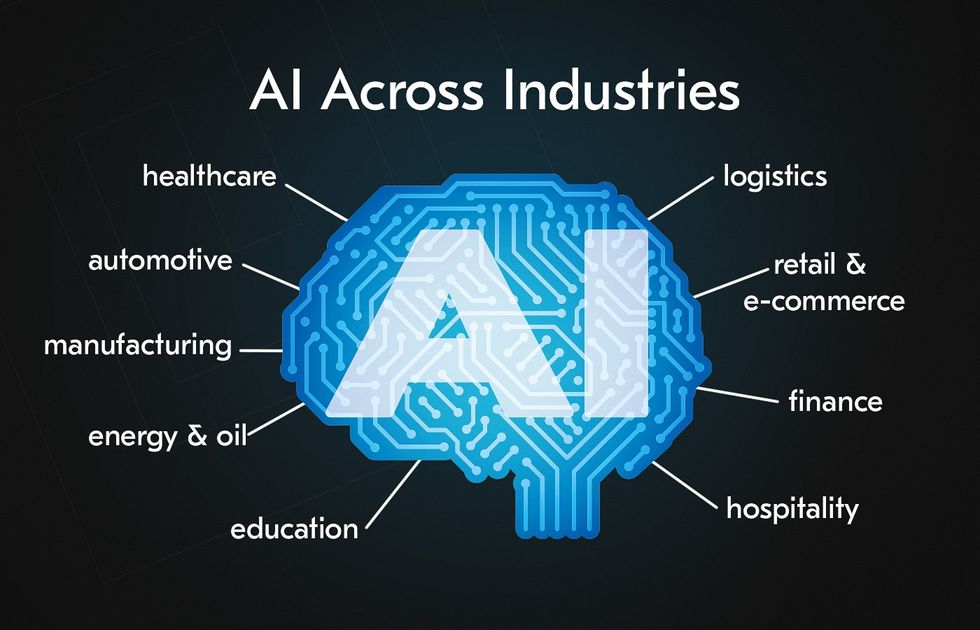
Adoption by Industry: Where AI Usage Is Highest
Let’s examine specific industries to understand competitive dynamics:
Technology and Software (85-90% adoption)
What they’re using AI for:
- Product development and feature enhancement
- Customer support automation
- Code generation and debugging
- Market research and competitive analysis
Competitive dynamics: AI is table stakes. Companies not using AI are non-competitive. Differentiation comes from how AI is implemented, not whether it’s used.
Australian context: Local tech companies like Atlassian, Canva, and SafetyCulture are heavily AI-integrated. Australian tech SMEs must match this or risk appearing outdated.

Financial Services (75-80% adoption)
What they’re using AI for:
- Fraud detection and risk assessment
- Customer service chatbots
- Loan application processing
- Investment analysis and algorithmic trading
- Regulatory compliance monitoring
Gartner research indicates that banks and financial institutions using AI for risk assessment reduce losses 25-40% while processing applications 60% faster.
Competitive dynamics: Customer-facing AI (chatbots, instant loan decisions) creates expectation setting. Consumers now expect immediate responses and rapid processing.
Australian context: Major banks (CommBank, NAB, Westpac) have deployed AI extensively. Smaller financial services firms must offer comparable service speed or explain why they’re slower.
Professional Services (60-70% adoption)
Includes accounting, legal, consulting, marketing agencies.
What they’re using AI for:
- Document analysis and review
- Research and information synthesis
- Report and presentation generation
- Client deliverable creation
- Time tracking and billing optimisation
Harvard Business Review research on consulting firms found that consultants using AI tools complete projects 25-40% faster with maintained or improved quality.
Competitive dynamics: Firms using AI can either:
- Reduce pricing while maintaining margins (volume strategy)
- Maintain pricing while improving margins (profitability strategy)
- Offer faster delivery at premium pricing (service differentiation)
Non-AI firms face margin compression regardless of strategy chosen.
Australian context: Professional services in Australia are heavily regulated (accounting standards, legal requirements), creating opportunities for AI that ensures compliance while improving efficiency.

Retail and E-commerce (55-65% adoption)
What they’re using AI for:
- Inventory optimisation and demand forecasting
- Personalised product recommendations
- Dynamic pricing
- Customer service chatbots
- Marketing content generation
Shopify’s research shows retailers using AI see 25-35% higher conversion rates and 15-25% lower inventory carrying costs.
Competitive dynamics: Online retail is especially AI-intensive. Amazon sets customer expectations (personalisation, instant support, next-day delivery) that smaller retailers struggle to match without AI assistance.
Australian context: Physical retail still significant in Australia, but AI advantages (inventory optimisation, marketing efficiency) apply equally to brick-and-mortar operations.
Healthcare and Medical Services (45-55% adoption)
What they’re using AI for:
- Diagnostic assistance and image analysis
- Administrative automation (scheduling, billing, records)
- Treatment planning and drug interaction checking
- Patient communication and triage
- Predictive health monitoring
Deloitte’s healthcare AI analysis indicates AI-assisted diagnostics improve accuracy 5-15% while reducing time to diagnosis by 30-50%.
Competitive dynamics: Regulatory requirements slow adoption, but once approved, AI becomes standard of care. Practices not using diagnostic AI may face liability issues if misdiagnoses would have been caught by AI.
Australian context: TGA and AHPRA create regulatory complexity. Opportunities exist for AI that handles administrative burdens (scheduling, Medicare billing, patient communication) without requiring medical approval.
Manufacturing (40-50% adoption)
What they’re using AI for:
- Predictive maintenance
- Quality control and defect detection
- Supply chain optimisation
- Production scheduling
- Demand forecasting
McKinsey’s manufacturing AI research documents 10-20% productivity improvements and 15-25% reduction in downtime with AI-optimised operations.
Competitive dynamics: Manufacturing is capital-intensive with thin margins. AI creating 10-20% efficiency improvements directly impacts profitability and competitive pricing.
Australian context: Australian manufacturing competes with lower-cost offshore production. AI-driven efficiency helps maintain competitive positioning.

Hospitality and Food Services (30-40% adoption)
What they’re using AI for:
- Reservation and booking management
- Menu optimisation based on demand patterns
- Inventory and waste reduction
- Staff scheduling optimisation
- Customer preference tracking and personalisation
Competitive dynamics: Lower adoption rates create opportunity. Early-moving restaurants and hotels capture advantages in customer experience and operational efficiency.
Australian context: Tourism-dependent businesses (hotels, restaurants in tourist areas) compete globally. AI-powered marketing and operations help small Australian businesses compete with international chains.
Construction and Trades (20-30% adoption)
What they’re using AI for:
- Project planning and scheduling
- Material cost estimation and ordering
- Safety compliance monitoring
- Client communication and updates
- Document and contract management
Competitive dynamics: Lowest adoption rates among major industries. Significant first-mover advantages available for contractors using AI systematically.
Australian context: Skilled labour shortages in Australian construction make AI-powered efficiency particularly valuable. Companies maximising productivity per worker gain significant advantages.
AI Applications by Business Function
Beyond industry, examining AI usage by business function reveals where competitive advantages emerge:
Marketing (78% adoption rate)
Specific applications:
- Content creation (blog posts, social media, ad copy)
- SEO optimisation and keyword research
- Email campaign personalisation
- Ad performance optimisation
- Social media scheduling and management
HubSpot data shows marketing teams using AI increase output 3-5x while reducing cost per lead 20-30%.
Competitive impact: Businesses using AI marketing produce more content, test more variations, and optimise faster than manual competitors.

Sales (63% adoption rate)
Specific applications:
- Lead scoring and qualification
- Proposal and pitch generation
- Meeting preparation and research
- CRM data entry and maintenance
- Sales forecasting
Salesforce research indicates AI-assisted sales teams achieve 25-30% higher win rates and 35-40% faster deal cycles.
Competitive impact: Sales organisations with AI qualification can afford to pursue more opportunities, losing fewer deals to competitor responsiveness.
Customer Service (71% adoption rate)
Specific applications:
- Chatbots for tier-1 support
- Response drafting for complex inquiries
- Sentiment analysis for escalation prioritisation
- Knowledge base optimisation
- Customer health scoring for retention
Gartner’s customer service research shows AI handling 60-70% of routine inquiries at 1/10th the cost of human agents while improving response times from hours to seconds.
Competitive impact: Customer expectations now set by AI-powered service (instant responses, 24/7 availability). Manual-only service appears slow and unresponsive by comparison.
Operations (52% adoption rate)
Specific applications:
- Process automation
- Inventory optimisation
- Supply chain forecasting
- Quality control
- Resource allocation
Competitive impact: Operational AI directly impacts costs and efficiency. 15-30% improvements translate immediately to margin advantages or pricing power.

Competitive Segmentation: Where Is Your Competition?
Understanding aggregate adoption rates matters less than understanding your specific competitive set.
Competitive Segment A: AI Leaders (15-20% of businesses)
Characteristics:
- Systematic AI implementation across multiple functions
- Dedicated resources for AI development
- Measurable ROI from AI initiatives
- AI integrated into competitive strategy
Strategic position: Building compounding advantages through experience and data accumulation.
Your response if competing against them: Match their AI sophistication or differentiate on dimensions where AI matters less (highly personalised service, local relationships, regulatory expertise).
Competitive Segment B: AI Adopters (35-40% of businesses)
Characteristics:
- Using AI tools in 1-3 business functions
- Experimental rather than systematic
- Partial implementation, inconsistent usage
- ROI uncertain or unmeasured
Strategic position: Capturing some efficiency gains but not systematic advantages.
Your response: Systematic, well-implemented AI in key functions can leapfrog this segment despite their earlier adoption.
Competitive Segment C: AI Observers (30-35% of businesses)
Characteristics:
- Aware of AI, planning to implement “eventually”
- Limited to no current usage
- Watching competitors’ moves
- Concerned about complexity or cost
Strategic position: Falling behind AI adopters in efficiency and capability.
Your opportunity: Moving from this segment to Segment B creates immediate competitive advantages.

Competitive Segment D: AI Resistors (10-15% of businesses)
Characteristics:
- Actively dismissive of AI relevance
- No plans for adoption
- Relying on traditional competitive advantages
Strategic position: Increasingly uncompetitive in efficiency-driven markets.
Long-term outlook: Many businesses in this segment will exit markets over next 3-5 years as cost structures become unsustainable.
Geographic Differences in Australian AI Adoption
Major Metropolitan Markets (Sydney, Melbourne, Brisbane)
Adoption rates: 30-35% (above national average)
Higher adoption driven by:
- Greater access to AI talent and training
- More competitive pressure from tech-forward competitors
- Customer bases with higher digital expectations
Regional and Rural Markets
Adoption rates: 15-20% (below national average)
Lower adoption creates opportunity:
- First movers in regional markets face less AI-sophisticated competition
- Local market knowledge + AI efficiency = defensible advantages
- Lower customer expectations create breathing room for learning

What This Intelligence Means for Your Strategy
If your industry has high AI adoption (60%+):
AI is table stakes, not differentiator. You must implement to remain competitive. Focus strategy on how you use AI differently or better than competitors.
If your industry has moderate adoption (40-60%):
Strategic window exists. Early systematic implementation creates 12-24 month advantages before adoption becomes standard.
If your industry has low adoption (below 40%):
Significant first-mover advantages available. Combination of AI efficiency + industry expertise creates defensible competitive moats.
Strategic action planning:
- Audit your direct competitors’ AI usage (website chatbots, content frequency, response times, service capabilities)
- Identify gaps where AI could create differentiation
- Prioritise AI implementation in areas where competitors are weakest
- Measure competitive metrics pre and post-implementation
At My Learning Online’s AI for Small Business course, we help Australian SME leaders:
Competitive analysis frameworks:
- How to assess competitors’ AI sophistication
- Identifying strategic gaps and opportunities
- Benchmarking your capabilities against industry standards
Strategic positioning:
- Where to implement AI for maximum competitive impact
- Defending against AI-powered competitors
- Communicating AI capabilities to customers and stakeholders
Implementation roadmaps:
- Developing your AI strategy based on competitive dynamics
- Prioritising investments for optimal ROI
- Building organisational capability systematically
The investment: From $35/week with flexible payment plans
The outcome: Strategic AI capability informed by competitive intelligence
The approach: Practical implementation, not academic analysis
The Competitive Reality
Your competitors are making AI investment decisions right now. Some are building systematic capabilities. Others are experimenting ineffectively. A few are ignoring AI entirely.
Where you position yourself in this landscape over the next 12-24 months will significantly impact your competitive position for the next decade.
Enrol in AI for Small Business at My Learning Online and build strategic AI capability based on competitive intelligence, not speculation.
Understand the competitive landscape. Position strategically. Start at My Learning Online today.