


The conversation about AI in business has shifted from “should we” to “how do we.”
For Australian SME leaders, the strategic question isn’t whether AI will transform operations—it’s how to implement it systematically across departments to capture competitive advantage before your market catches up.
The data is unambiguous: organisations implementing AI strategically are pulling ahead rapidly, while those taking a wait-and-see approach are falling behind in measurable ways.
This article provides a department-by-department framework for AI implementation, built on documented outcomes from Australian and international businesses that have already made the shift.

The Strategic Context: Why Departmental AI Matters
McKinsey’s research on AI adoption reveals that high-performing organisations don’t implement AI as isolated experiments. They deploy it systematically across functions, with 63% of leading adopters reporting AI use in four or more business areas.
The Australian Industry Group’s Technology Survey found that while 35% of Australian manufacturers and service businesses report using some AI tools, only 12% have strategic, cross-functional implementation. That gap represents opportunity.
For SME leaders, the implication is clear: piecemeal adoption delivers limited returns. Strategic, multi-department implementation creates compounding efficiency gains and defensible competitive advantages.
Let’s examine how AI drives measurable improvement in each key department. A framework we’ve implemented here at the Learning Online Group, that’s already proving to not only increase efficiency, but is allowing us to re-allocate resources to our most critical areas of the business to drive better outcomes for our students.
Sales: From Administration to Strategic Selling
The Current State
Sales professionals spend approximately 65% of their time on non-selling activities, according to Salesforce research. Lead qualification, data entry, proposal writing, follow-up scheduling, and performance reporting consume hours that should be spent with prospects and customers.
AI Applications with Documented ROI
Lead qualification and scoring: AI analyses prospect behaviour, engagement patterns, and firmographic data to prioritise leads by conversion probability. HubSpot’s State of Sales Report documents that teams using AI lead scoring see 25-30% improvement in conversion rates because reps focus energy on high-probability opportunities.
Proposal and pitch generation: AI drafts customised proposals using templates, product information, and prospect-specific data. Reps spend 15 minutes refining instead of 2 hours creating from scratch.
Meeting preparation: AI summarises previous interactions, analyses prospect’s company news, and suggests talking points. Sales teams using AI research tools report 40% faster deal cycles.
Performance analytics: AI identifies patterns in successful deals, helping managers coach teams on replicable behaviours rather than relying on intuition.
Does it work? Adrian Prokopiec, former Head of Digital at Lifestyle Communities, Australia’s leading provider of Community Living for Over 50’s agrees: “Lead Scoring utilising AI across our email, SMS, web and social media, allowed us to identify the most likely to convert customers, who was most suited for particular home types and communities and allowed us to reach record sales in 2022“

Strategic Implementation Note
The key is automating the workflow around selling, not the relationship-building itself. Harvard Business Review’s analysis of AI in sales emphasises that top performers use AI to free up time for higher-value human interactions—the consultative, relationship-building work that drives enterprise sales.
For Australian SMEs, this means your sales team can compete effectively against larger competitors by augmenting each rep’s capacity.
Marketing: Scaling Content and Personalisation
The Current State
Marketing departments face mounting pressure to produce more content, across more channels, with greater personalisation—all while managing static or shrinking budgets. Content Marketing Institute research shows that 70% of B2B marketers report increasing content demands but struggle with bandwidth constraints.
AI Applications with Documented ROI
Content creation at scale: AI generates blog posts, social media content, email campaigns, and ad copy. Jasper AI’s documented case studies show marketing teams increasing content output 3-5x while maintaining quality standards.
SEO optimisation: AI tools analyse search intent, identify content gaps, and optimise existing content for featured snippets and rankings. Small businesses report 40-60% increases in organic traffic within 6 months of systematic AI-powered SEO implementation.
Audience segmentation and personalisation: AI analyses customer data to create micro-segments and personalise messaging. Salesforce Marketing Cloud data indicates that AI-powered personalisation increases email open rates by 25-30% and conversion rates by 15-20%.
Campaign performance analysis: AI identifies which creative, messaging, and channels drive results, allowing rapid optimisation. Marketing teams redirect budget from underperforming channels to high-ROI activities in days instead of quarters.
Strategic Implementation Note
The Australian market presents unique opportunities. Most of your competitors aren’t yet using AI systematically for marketing. First movers capture disproportionate attention in search results, social algorithms, and customer mindshare.
At My Learning Online, we’ve designed our AI curriculum to address the specific marketing challenges Australian SMEs face—building authority in competitive markets, creating localised content, and optimising for Australian search patterns.

Operations: Process Optimisation and Decision Support
The Current State
Operations leaders manage complex workflows with limited visibility into inefficiencies. Manual processes, data silos, and reactive (rather than predictive) management create operational drag that compounds as businesses scale.
AI Applications with Documented ROI
Process automation: AI handles repetitive workflows—invoice processing, inventory reordering, scheduling optimisation, compliance documentation. Deloitte’s automation research documents 30-50% time savings in back-office functions with automation.
Predictive maintenance and inventory: AI analyses usage patterns to predict equipment failures or inventory needs before they become urgent problems. Manufacturing and retail businesses report 15-25% reduction in stockouts and overstock situations.
Quality control: AI vision systems identify defects or anomalies faster and more consistently than manual inspection. Error rates drop 40-60% with AI-assisted quality processes.
Supply chain optimisation: AI analyses multiple variables (demand forecasting, supplier reliability, logistics costs) to optimise procurement and distribution. McKinsey supply chain research shows 15-20% cost reductions with AI-optimised supply chains.
Strategic Implementation Note
Operations AI delivers some of the most measurable, quantifiable ROI. These aren’t soft benefits—they’re hard cost savings and efficiency gains that flow directly to bottom-line profitability.
For Australian SMEs competing with larger organisations, operational AI levels the playing field. You can deliver enterprise-level efficiency and reliability without enterprise-level headcount.

Customer Service: Scaling Support Without Scaling Costs
The Current State
Customer expectations for response time and availability have increased dramatically. Microsoft’s State of Customer Service Report found that 77% of consumers have higher service expectations than three years ago, with 24/7 availability increasingly seen as standard.
Scaling human customer service proportionally to customer growth destroys unit economics for most SMEs.
AI Applications with Documented ROI
Intelligent chatbots: AI handles common inquiries, troubleshooting, and routing automatically. Gartner research indicates that AI chatbots can resolve 60-70% of routine inquiries without human escalation.
Sentiment analysis: AI monitors customer communications (emails, chats, calls) to identify dissatisfaction early. Service teams proactively address issues before they escalate to complaints or churn.
Response drafting: AI generates customised response templates based on customer inquiry context, reducing response time from hours to minutes. Service reps refine AI drafts rather than writing from scratch.
Knowledge base optimisation: AI analyses which questions customers ask most frequently and identifies gaps in self-service documentation. Support ticket volume drops 20-30% with AI-optimised knowledge bases.
Strategic Implementation Note
The economics are compelling: Each support rep costs $45,000-65,000 annually in Australia. AI tools that handle 60-70% of routine inquiries cost $50-200 monthly.
For growth-oriented SMEs, this means you can scale customer support in proportion to revenue growth without proportional cost increases—fundamentally improving unit economics.

Finance and Administration: Accuracy and Speed
The Current State
Finance teams spend excessive time on data entry, reconciliation, reporting, and compliance documentation. ACCA’s research on accounting automation finds that 75% of finance professionals believe automation will transform their roles within five years.
AI Applications with Documented ROI
Automated bookkeeping: AI extracts data from invoices, receipts, and bank statements, categorises transactions, and identifies anomalies. Reconciliation time drops 50-70%.
Financial forecasting: AI analyses historical data, seasonal patterns, and external factors to generate rolling forecasts. Finance leaders make better capital allocation decisions with predictive rather than reactive data.
Expense management: AI reviews expense claims against policy, flags anomalies, and routes approvals automatically. Compliance improves while processing time decreases.
Reporting automation: AI generates management reports, board decks, and compliance documentation by pulling data from multiple systems. CFOs report 40-60% time savings on routine reporting.

The Cross-Functional Implementation Framework
Successful AI implementation isn’t about deploying tools randomly—it’s about systematic rollout that builds organisational capability.
Phase 1: Pilot and Proof (Months 1-2)
Select 2-3 high-impact, low-complexity use cases. Document baseline metrics. Implement AI solutions. Measure improvement. Build internal case studies.
Phase 2: Departmental Expansion (Months 3-6)
Roll out proven use cases across departments. Train teams on AI tools relevant to their functions. Establish governance and best practices.
Phase 3: Strategic Integration (Months 7-12)
Connect AI tools across systems. Automate cross-functional workflows. Use AI for strategic decision support, not just task automation.
MIT Sloan’s research on AI transformation emphasises that successful organisations treat AI as a change management challenge, not just a technology deployment.
Building Organisational AI Capability
Here’s the strategic insight most leaders miss: tools alone don’t create competitive advantage. Organisational capability—teams that know how to leverage AI effectively—creates defensible competitive moats.
This requires systematic training, not ad-hoc experimentation.
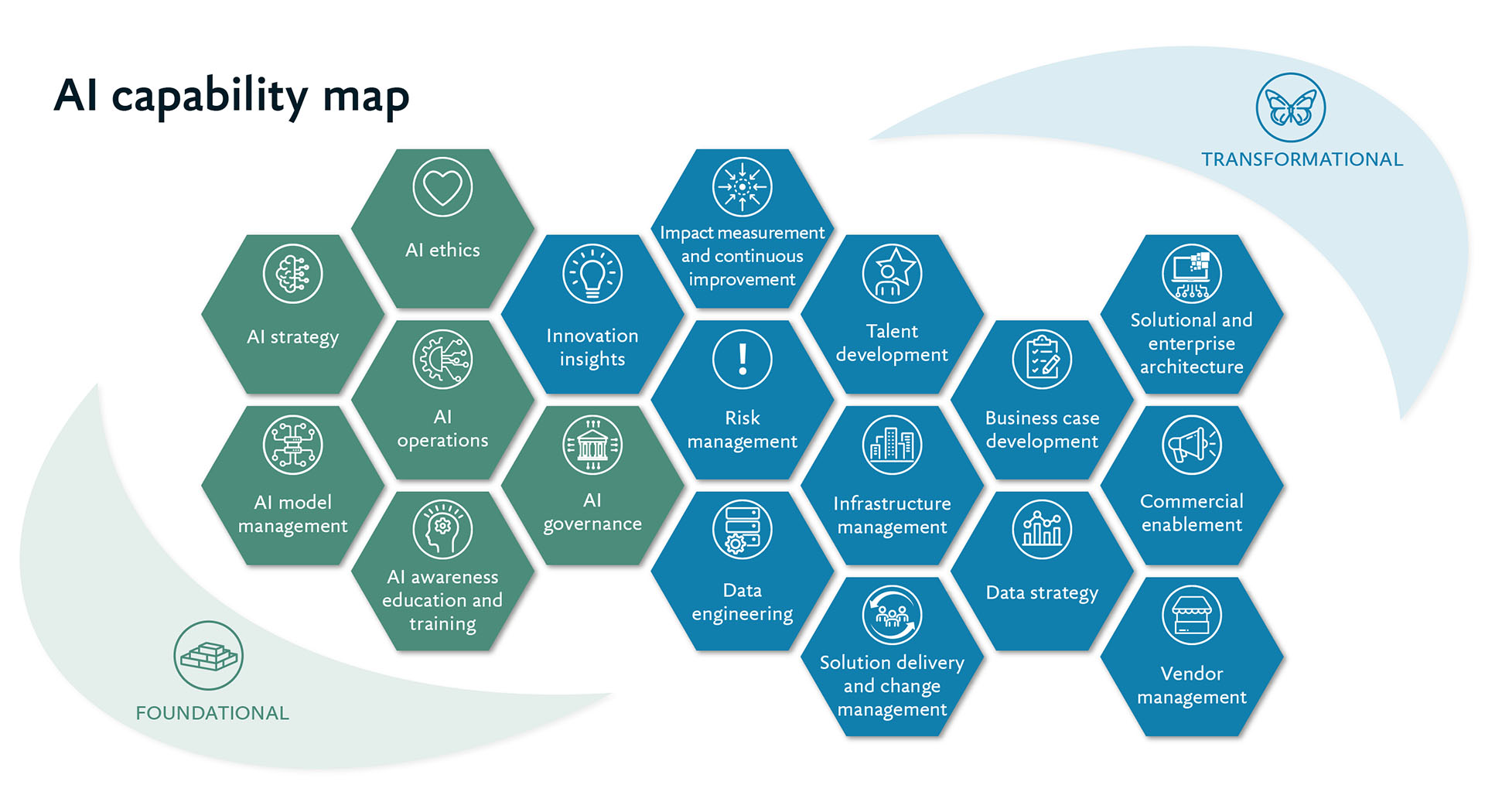
At My Learning Online, our AI for Small Business course is designed specifically for this challenge. You’ll learn:
- How to identify high-impact AI opportunities in each department
- Which tools solve which problems (avoiding expensive trial-and-error)
- Implementation frameworks that minimise disruption
- Change management strategies for team adoption
- How to measure and report on AI ROI to justify continued investment
The curriculum is built for Australian SME leaders who need practical implementation guidance, not academic theory.
The investment: From $30/week through flexible payment plans
The outcome: Organisational AI capability that compounds over years as your team builds expertise
The Cost of Delayed Implementation
Let’s address the elephant in the room: the opportunity cost of waiting.
BCG’s research on AI competitive dynamics demonstrates that first movers in AI adoption achieve 2-3x productivity gains compared to fast followers, and 5-6x gains compared to laggards.
The gap widens quickly because:
- Cumulative learning effects: Teams using AI for 12 months outperform teams starting today, even with identical tools
- Data advantages: AI systems improve with usage data; early adopters have more data
- Market positioning: Customers come to expect AI-enabled service levels from early adopters
Translation: Your competitors who implemented AI six months ago aren’t just six months ahead. They’re building compounding advantages that widen the gap continuously.
For Australian SME leaders, the strategic question becomes: Are you leading this shift in your industry, or catching up to those who did?

Making the Business Case Internally
CFOs and boards want ROI justification. Here’s the framework:
Quantifiable benefits (12-month projection):
- Sales efficiency: 25-30% more deals per rep = additional revenue
- Marketing output: 3-5x content production = increased pipeline
- Operations savings: 30-50% time reduction in back-office = reduced labour costs
- Customer service: 60-70% inquiry automation = reduced support costs per customer
Investment required:
- AI tools: $200-500/month for comprehensive suite
- Training: Course investment of $30/week per leader
- Implementation time: 20-30 hours over 3 months for core team
For a 25-person business, implementing AI across departments typically delivers ROI within 4-6 months, with ongoing benefits compounding annually.
Your Strategic Next Step
The businesses that dominate Australian markets in 2027 will be those that built AI capability in 2025.
You can lead that transformation in your organisation, or you can explain to your board why competitors are capturing market share with superior efficiency and service levels.
The technical barriers are lower than ever. The strategic challenge is organisational: building team capability, managing change, and implementing systematically.
Enrol in AI for Small Business at My Learning Online and equip yourself with the framework to lead AI transformation across your organisation.
The course is designed specifically for Australian business leaders who need practical implementation guidance for real-world SME challenges.
Lead your organisation into the AI era. Explore our strategic AI implementation curriculum at My Learning Online.